The Game Nobody Bets On: Why Your Bankroll Needs a Money-Free Sanctuary
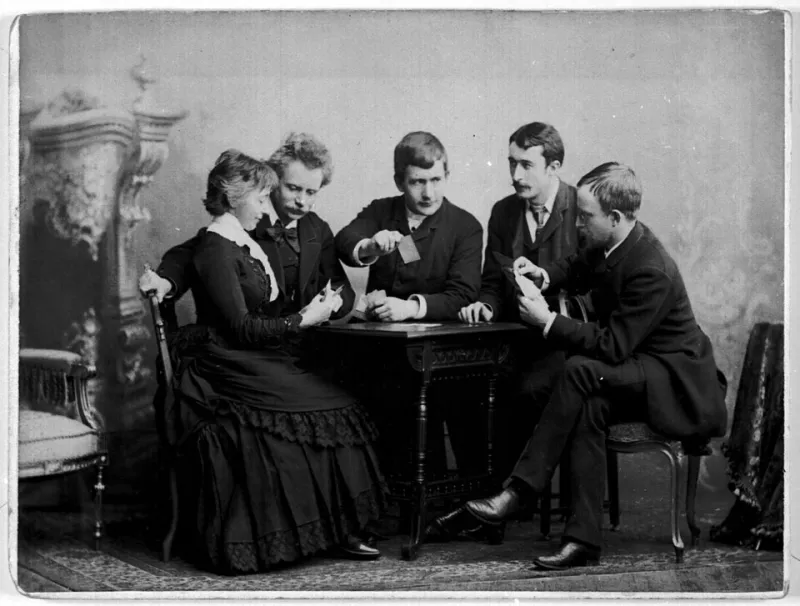
Photo: Bergen Public Library Norway from Bergen, Norway, No restrictions, via Wikimedia Commons
Every poker player I know can name their bankroll, their win rate, and the exact amount they dropped last month. Almost none of them can name the last time they played cards just to play cards.
That's a problem, and it's one the American online casino scene rarely talks about. We obsess over RTP percentages, withdrawal speeds, and whether a platform's license checks out — all worthy obsessions, and ones we cover constantly here. But there's a quieter piece of player health that no wagering requirement calculator will catch: what happens to your head when every single hand you play has money attached to it.
The Table Where Nothing Is For Sale
Spend any time around Vietnamese card culture and you'll notice something American gambling circles tend to miss. Games like Tiến Lên exist in two parallel universes. One version runs on money. The other runs entirely on pride, trash talk, and the sacred right to remind your cousin that he lost with a pair of twos for the next eleven months.
The no-money version isn't a lesser version. It's not practice. It's not a stepping stone to the real tables. It's its own thing — a game played for the pure mechanics of it, where a brutal losing streak costs you nothing but your dignity at the next family gathering.
My proposal for American players is simple: everyone who gambles with real money should keep one card game they never, under any circumstances, play for cash. Call it your sanctuary game. Play it under a fake screen name if you want — the point is that it lives completely outside your gambling life.
What a Zero-Stakes Game Actually Does for You
This isn't just a nice idea. There's real mechanics underneath it.
It separates the game from the outcome. Tilt — the emotional spiral that turns one bad beat into five reckless deposits — feeds on the gap between what you expected and what you lost. When you regularly play a game where losing is genuinely free, you retrain your brain to experience cards as cards. The hand is the hand. The result is the result. That muscle memory carries over when you sit back down at a real-money table and the stakes start whispering in your ear.
It kills the chase before it starts. Chasing losses happens when the game becomes a debt to be repaid. Your sanctuary game can't be a debt. When you lose ten hands of free Tiến Lên in a row, there's nothing to win back — so you just keep playing, loosen up, try that aggressive three-of-a-kind run you'd never risk real money on. You remember that cards are supposed to be fun, which sounds corny until you watch someone on a Tuesday night at 1 a.m. making their fourth deposit to "get even."
It's a burnout circuit breaker. Real-money play is work, even when it's fun. There's variance to survive, decisions to second-guess, sessions to review. A money-free game is the decompression chamber between sessions. Players who burn out of online poker usually don't burn out of cards — they burn out of the weight attached to every card. The sanctuary game keeps the love of the game alive without the invoice.
The American Blind Spot
Here in the US, we have a cultural allergy to the idea of playing without a payoff. If you're doing something, the thinking goes, you should be earning or winning or at least optimizing. Casual play reads as a waste of time.
But ask any old-school home game host: the players who last decades aren't the ones chasing the biggest score. They're the ones who'd still show up if the stakes were a bag of chips — the literal, crunchy kind. Longevity at the tables is a skill, and like any skill, it's built in low-pressure environments.
The Vietnamese tradition gets this right. Play and profit live in separate rooms, and nobody confuses the two. The family game after dinner isn't secretly training anyone for the casino; it's just the game, enjoyed on its own terms. That separation is a form of discipline — arguably a stricter one than any staking plan.
How to Build Your Own Sanctuary Game
Ready to adopt the habit? A few ground rules:
- Pick one game and commit. Ideally something with real depth — Tiến Lên, a shedding variant, even a free-to-play app version of your favorite. Shallow games get boring fast; deep games reward the hundreds of hours you'll pour in.
- Hard rule: never money. Not "usually," not "except that one time." The whole value collapses the moment stakes creep in.
- Keep it separate from your gambling identity. Different username, different app, different circle of friends if possible. This is the fake-name table — the version of you that plays for nothing but the game.
- Use it as a reset, not a warm-up. If you're tilting at the real-money tables, close the app and go lose free hands for twenty minutes. Don't treat the sanctuary game as practice for your comeback; treat it as the exit ramp.
The Bottom Line
We spend a lot of ink at GameNoHu Uy Tín helping players find trustworthy platforms, decode bonus terms, and spot the sketchy sites. That work matters. But the most important safeguard in gambling isn't on any casino's homepage — it's the relationship you have with the games themselves.
Keep one table where nothing is for sale. It costs zero dollars, and it might be the reason you're still playing, happily and sanely, ten years from now.